
Developing optical elastography for tumour detection during breast-conserving surgery

We are happy to announce our RPMI Festival 2026 keynote speaker Brendan Kennedy! He is full professor at the University of Western Australia with a research focus on bioengineering. His team develops and translates biophotonics imaging techniques for use in a range of applications, from medical devices for use during cancer surgery to high resolution optical microscopy techniques for use in mechanobiology and tissue engineering.
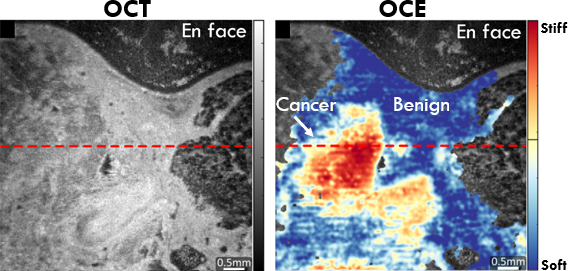
Intraoperative cancer detection using optical coherence elastography
In many operations, surgeons must rely on their eyesight and sense of touch to determine if cancer has been fully removed. This often leads to residual cancer remaining in the patient after surgery, requiring either follow-up surgery or increased chances that the cancer will metastasize. In breast-conserving surgery, for example, ~20% of patients require additional surgery because the pathologist identifies cancer at the boundary of the excised tissue. Additionally, with the continued development of laparoscopic and robotic surgeries, it is increasingly important to develop methods to visualise tissue deep within the body at the point of excision.
Biophotonics offers high resolution imaging solutions to map tissue microstructure and can be implemented in compact imaging probes, making it well-placed to address these issues. A range of techniques have been demonstrated for intraoperative use, including optical coherence tomography (OCT), Raman spectroscopy, photoacoustic tomography and fluorescence microscopy.
OCT, often referred to as the optical equivalent of ultrasound, is particularly suited to many surgical applications. However, many reports indicate that it is challenging to distinguish tumour from surrounding stroma using OCT, reducing its clinical potential. To address this, functional OCT techniques have been developed to provide additional contrast. Our group focusses on mechanical contrast, i.e. identifying cancer based on its elevated stiffness. In this approach, known as optical coherence elastography (OCE), a mechanical load is applied to tissue and OCT is used to map the resulting deformation on the micro-scale.
In this talk, I will describe our journey in developing OCE from preliminary studies on excised tissue to in vivo probes for use in the surgical cavity and the creation of a spin-out company, OncoRes Medical, that is commercialising the technology with the goal of achieving market approval and widespread deployment of the technology globally
(Image courtesy Brendan Kennedy)